

A white-label SEO audit should tell an agency exactly what was checked, which URLs need attention and what the client can safely approve. This checklist helps agency owners review outsourced technical SEO, on-page findings, audit documentation and handoffs without treating automated warnings as verified problems.
Visual guide: review white-label SEO deliverables
A quality review should make the outsourced work understandable and safe to approve. Define ownership, inspect the recommendations, verify implementation and communicate the results to the client without promising rankings that no provider can guarantee.
Why agencies need a clear quality standard
White-label SEO allows an agency to deliver search work under its own client relationship while a specialist handles research, auditing or implementation. The model can help a small team support more accounts, but it also introduces risk. A client expects the agency to know what has been done, why it matters and what evidence supports the work. Sending a report that nobody reviewed is not a quality-control process.
Start with an agreement about responsibilities. Who can change the live site? Who approves content? Who communicates with the client? What is a completed deliverable, and what remains a recommendation? These details need to be decided before anyone receives access. The best partnership is one where the agency can explain the work in plain language and the specialist can demonstrate it without exposing confidential accounts.
Define the deliverables before quoting a monthly fee
List exactly what is included: technical audit, keyword and search-intent research, on-page recommendations, content briefs, internal linking, outreach planning or reporting. Then define the level of implementation. An audit with a spreadsheet is different from fixing templates, publishing content or securing editorial mentions. If the package only includes recommendations, make that clear to the end client. Unclear boundaries turn normal questions into disputes.
Specify the website size, language, countries targeted, platform and existing constraints. A 20-page brochure site and a store with thousands of variants have different SEO workloads. Agree on a limited set of priorities for the first month and how changes will be approved. Avoid guaranteeing a particular number of rankings or links. Those outcomes depend on external systems and decisions that an SEO partner does not fully control.
Use a technical audit that points to real decisions
A useful technical report identifies affected URLs, the observed problem, impact, confidence and a recommended fix. If the tool says 800 pages have missing meta descriptions, ask whether those are indexable pages that need unique copy. If it reports duplicate URLs, check canonicals and redirects before recommending deletion. Automated tools identify patterns; they do not make editorial decisions. Review at least a sample of pages manually.
Core checks should include status codes, indexability, sitemaps, canonical tags, internal navigation, broken links, mobile templates and page experience. Google provides a useful SEO starter guide explaining the basics. When technical recommendations involve redirects, robots rules or templates, document the rollback plan and confirm a backup first. An agency should never learn that a global fix was deployed only after the client reports a problem.
Treat link building as editorial work, not a monthly number
Links can help search engines find and understand content, but a link is not automatically valuable because a spreadsheet shows a high authority metric. Check whether the referring page is relevant, useful and likely to be read by a real audience. Ask why that publisher would mention the business. A legitimate product comparison, research resource or local industry guide gives a better reason than an irrelevant article created mainly to place an exact-match anchor.
Google’s spam policies describe paid links and other schemes intended to manipulate rankings. Do not buy bulk links and disguise them as natural outreach. Sponsored placements should be appropriately qualified. Do not promise ‘100 high-DA backlinks’ without showing the real websites, relevance, editorial standards and whether those placements are ads. A monthly deliverable should be auditable, even when no links were earned.
What to check in an outreach opportunity
Before approving outreach, review the publisher’s audience, primary topics, article quality, visible contact information and site history. Does the website exist for its readers, or does every post contain unrelated promotional links? Would the client be comfortable having the brand mentioned there? Inspect the actual page, not just third-party metrics. A small industry resource may be more relevant to a specialist business than a large general blog.
Keep a record of outreach attempts and responses without collecting more personal data than necessary. Use lawful, respectful contact methods and do not misrepresent who is writing. When discussing a mention, let the editor decide whether the reference is useful. An honest monthly report may show useful pitches sent, replies received, placements earned and opportunities rejected. It should never substitute a fake success count for work that can be verified.
Review on-page optimization for usefulness
An on-page update should explain what a visitor needs, not repeat keywords to satisfy an audit score. Check whether the intended reader can tell what the page offers, how it is different and what action comes next. Review the title, main heading, service scope, FAQs, proof, images and internal links together. There should be a distinct purpose for every important page. If two pages target nearly identical searches with similar content, discuss whether they serve different needs.
Google’s link guidance recommends crawlable anchors with descriptive text. Internal linking should help a visitor move from a broad explanation to a relevant service or related resource. Do not insert dozens of identical anchors to the same sales page. An agency that needs a scoped review can compare ScaleKin’s white-label SEO service with a focused website mini audit.
A monthly report should tell the client what changed
Begin with the work completed, including page URLs, dates and the status of each recommendation. Separate shipped changes from drafts waiting for client approval. Show meaningful metrics where data is available: organic clicks, impressions, relevant queries, qualified enquiries or sales. Explain important changes in the site or analytics setup that might influence the comparison. One month’s ranking movement may be affected by competition, demand or Google changes.
Give the client a concise next-action plan instead of a long chart dump. Identify two or three tasks that matter most and explain who is responsible for them. For link outreach, show confirmed placements separately from conversations and pending opportunities. Never present unverified publisher metrics as fact. An agency should be able to open the underlying source for every claimed deliverable.
Protect credentials, approvals and client ownership
An outside specialist often needs temporary access to WordPress, Search Console, analytics or a project board. Provide the minimum permissions required. Use separate named accounts and remove access when the engagement ends. Share passwords only through an approved secure method, not through ordinary project comments or spreadsheets. Record where work is stored, who owns the deliverables and who can publish changes.
Agree on confidentiality and whether the specialist may show the project in a portfolio. Client screenshots and performance data should not appear in another agency’s sales materials without permission. When working through staging, track what version of the site the specialist inspected. If a client updates the page during review, reconcile those changes rather than overwriting them. Clear access and approval rules protect the relationship more effectively than vague promises of secrecy.
How to choose the first 30 days of a partnership
Week one should focus on access, existing data, priorities and risk. Week two can produce a reviewed technical and content plan. Week three is for approved improvements on a limited set of pages. Week four should verify those changes and agree on what is next. The exact schedule depends on the site’s size and approvals; it is a planning example rather than a fixed service guarantee.
Choose a pilot that gives the agency a real chance to assess communication and deliverable quality. Ask for a sample audit finding with evidence, a sample change log and a report format. Once the process works, expand the scope deliberately. ScaleKin can support organic SEO implementation and technical review, but the client-facing agency should still own final approval and strategy decisions.
What to include in a white-label SEO audit report
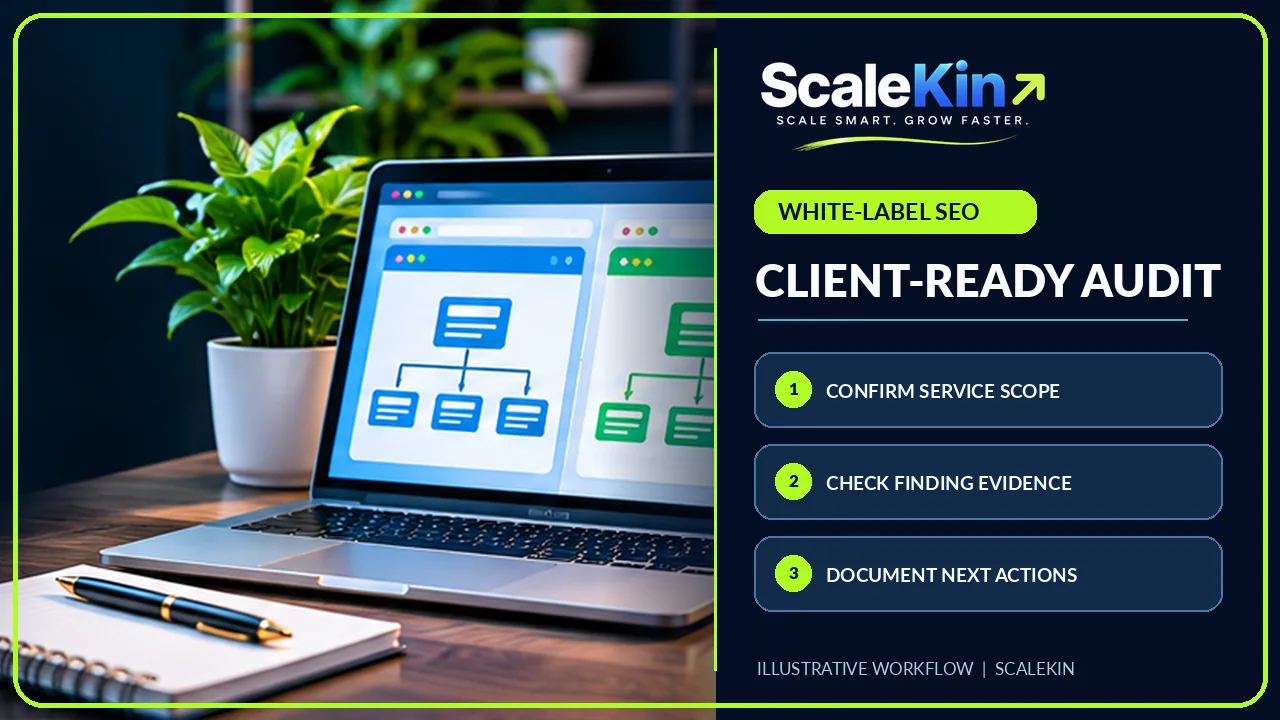
A useful white-label SEO audit separates observed issues from recommendations. For each finding, record the affected URL, evidence, expected impact, priority, owner and approval status. A report with hundreds of generic warnings is not yet a client-ready action plan.
- Crawl and indexing: confirm status codes, sitemap references, indexable pages, canonical intent and blocked URLs.
- On-page relevance: compare page purpose, search intent, titles, headings and useful content before rewriting.
- Internal links: identify important pages that are hard to reach or have misleading anchor text.
- Implementation evidence: distinguish work completed, work waiting for approval and items that need developer support.
- Measurement: use Search Console and other available first-party data to establish a baseline without promising specific ranking results.
White-label audit documentation: sample handoff fields
Give the client-facing agency a change log with these columns: Page URL, finding, evidence, severity, recommended fix, assigned owner, approval, implementation date and verification result. For example, “Collection page points to the wrong canonical” should include the observed canonical, expected canonical and a review of duplicate URLs before anyone changes the live site.
For a quick first-pass check of one public page, use the ScaleKin free SEO audit tool. A scoped, human-reviewed audit is different: see the Website SEO Mini Audit for its current deliverables and limits.
Questions agency owners ask before outsourcing
Can white-label SEO guarantee results? No responsible provider can guarantee a particular Google position or volume of traffic. Is link building always part of SEO? No. Some sites first need indexing, internal links and useful content. How do we report work under our brand? Agree on a shared format, change log and approval process. The specialist’s identity can remain private where agreed, but claims must still be accurate.
Should we outsource technical fixes? Only with a clear scope, backup, permission boundaries and testing. How do we measure the partnership? Review implementation quality, timeliness, communication and meaningful client outcomes over a suitable period. What if a placement is sponsored? Disclose it where required and use the appropriate link attributes. A low-risk partnership is easier to scale than a flashy report built on shortcuts.
About the author
Mohammed Tarikul Islam Shohan works with SEO, WordPress and channel growth projects at ScaleKin and is a Top Rated freelancer on Upwork. This guide describes responsible agency workflows and general quality checks, not confidential work or outcomes from a named customer.